

Why Do The Olympics Distribute Hundreds of Thousands of Condoms?
February 18, 2026 by
ellenyi@adultstoysgd.com
Market ReportIs the Olympic Village just a global sporting event, or is it the world’s most exclusive party?
Imagine 450,000 condoms. That was the staggering number distributed at the Rio 2016 Olympics. For the average person, this number sounds practically impossible, leading to wild speculation and endless tabloid gossip about what really happens inside the Olympic Village. It’s easy to get lost in the sensational headlines about athletes’ nightlife, ignoring the logistical mountain and serious medical planning required to keep thousands of young, fit individuals safe. But here is the reality: this isn’t just about "fun"—it is a massive, calculated global health strategy that involves complex supply chains, strict quality control, and international humanitarian efforts.
Why are condoms distributed at the Olympics?
Historically, the distribution of free condoms at the Olympic Games is a preventive public health measure mandated by the International Olympic Committee (IOC). First introduced at the 1988 Seoul Olympics to raise awareness during the height of the HIV/AIDS epidemic, the initiative serves two primary purposes: to protect athletes from sexually transmitted infections (STIs) such as HIV, syphilis, and gonorrhea, and to promote safe sex education globally. While the media focuses on the volume, organizers view the condoms—often branded with "Olympic Spirit" messaging—as essential medical supplies, akin to bandages or physiotherapy equipment, ensuring that athletes remain healthy and able to compete at their peak.
So, let’s peel back the wrapper and look at the fascinating history, the data, and the business reality behind this "Open Secret."
People Also Ask (Industry & Buyer Focus)
Understanding the logistics behind such a massive event is crucial for retailers and wholesalers in the adult wellness space. Here are the top questions regarding the business and safety side of Olympic condoms:
- Who pays for the condoms distributed at the Olympics?
Typically, the local Organizing Committee partners with major condom manufacturers (like Durex, Lifestyles, or sagami) who provide the products often as part of a sponsorship deal for global brand exposure. - What are the quality standards for condoms used in international events?
They must strictly adhere to ISO 4074 international standards, ensuring specific burst volume, freedom from holes, and package integrity to guarantee safety for a global user base. - Are the condoms at the Olympics standard or custom-made?
Most are standard lubricated latex condoms, but recent games have seen innovations, such as the "camouflaged" packaging in Tokyo or eco-friendly materials, showcasing industry trends. - Do athletes actually use all the distributed condoms?
Not necessarily. While usage is high, many athletes take them home as souvenirs because of the unique packaging, meaning the "distribution" numbers don’t always equal "usage" numbers. - How does the distribution logistics work for 450,000 units?
They are distributed via dispensing machines in the Olympic Village clinics and vending machines to ensure privacy and 24/7 accessibility without the embarrassment of face-to-face requests. - Does sex really affect athletic performance?
According to a study by Colorado State University, there is no physiological evidence that pre-competition sex negatively impacts flexibility, reaction time, or muscle strength. - Why is the US market readership so interested in this topic?
Data from Reddit and search engines shows high US interest, driven by the strong college sports culture and the openness of American athletes (like Ryan Lochte) discussing village life.
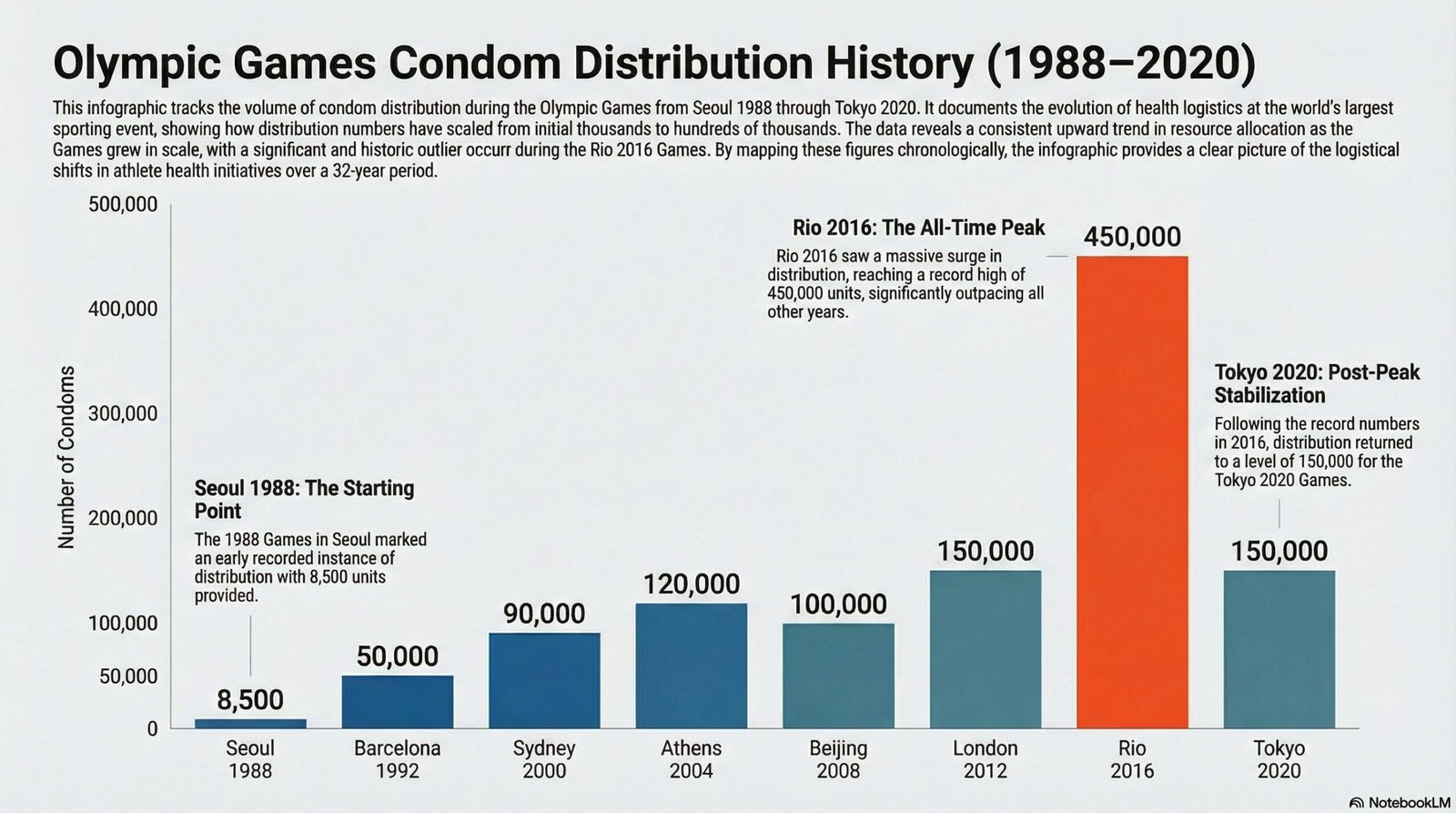
The Evolution: From 8,500 to 450,000
The tradition didn’t start with a bang—or at least, not a big one. The history of the "Olympic Condom" mirrors the world’s growing awareness of sexual health.
- 1988 Seoul: The debut. Only 8,500 condoms were distributed. It was a groundbreaking move to address the AIDS crisis.
- 1992 Barcelona: The number jumped to 50,000.
- 2000 Sydney: A massive leap to 90,000. Organizers realized they had underestimated demand.
- 2004 Athens: 120,000 provided.
- 2008 Beijing: 100,000 condoms, branded with the motto "Faster, Higher, Stronger."
- 2012 London: 150,000 supplied by Durex.
- 2016 Rio: The absolute record-breaker. 450,000 condoms (including 100,000 female condoms) were supplied. This wasn’t just about sex; it was a response to the Zika virus outbreak, which could be sexually transmitted.
- 2026 Milan-Cortina: A spokesperson stated that in line with tradition, access is guaranteed. To date, over 9,700 units have been made available in various territories as part of preventive measures.
The "Open Secret" of the Village
Why are these numbers so high? US swimmer Ryan Lochte famously told ESPN Magazine that likely "70% to 75% of Olympians" engage in sexual activity during the games.
It makes biological sense. You have thousands of the world’s most physically fit people, brimming with adrenaline and testosterone, locked in a closed village for weeks. As Lochte put it, when you gather the "most perfect bodies" on earth, interaction is inevitable.
However, the purpose goes beyond pleasure.
A Barrier for Life: The Health Mandate
The Organizing Committees aren’t just being "cool"; they are being responsible. The UNAIDS 2021 report highlighted that there were 37.7 million people living with HIV globally. With 1.5 million new infections in 2020 alone, large international gatherings are potential super-spreader events for STIs.
Condoms remain the most effective barrier against:
- HIV/AIDS
- Syphilis
- Gonorrhea
- Unwanted Pregnancies
Even during the Tokyo Olympics, where strict COVID-19 social distancing rules banned intimacy, condoms were still distributed. Why? The organizers explicitly stated: "The distribution is not for use at the Games, but to be taken back to your home countries to raise awareness."
This elevates the humble condom from a bedroom accessory to a tool of Humanitarianism. It is about taking the message of "Safe Play" back to over 200 countries.
Industry Perspective: Quality and Supply Chain
For buyers and wholesalers in the adult industry, the Olympics serves as a massive case study in quality assurance.
When sourcing products for such a high-stakes environment, "cheap" is not an option. The condoms distributed must meet rigorous ISO 4074 standards. This includes:
- Air Burst Testing: Ensuring the latex can expand without breaking.
- Electronic Testing: Checking for microscopic holes.
- Package Integrity: Ensuring the foil seal creates a perfect barrier against contaminants.
The "Olympic Standard" effectively sets the benchmark for consumer trust. If a brand is good enough for gold medalists, it serves as a powerful validation for retail consumers. Furthermore, the sheer volume requires a robust supply chain capable of delivering nearly half a million units without defects—a critical lesson for B2B procurement.
Conclusion
While the headlines will always focus on the "wild parties" inside the Olympic Village, the distribution of condoms is fundamentally a story of responsibility. It combines public health strategy with logistical excellence to protect our world’s best athletes. For the industry, it highlights the importance of quality manufacturing and the universal need for safety, proving that whether on the track or in the bedroom, protection is always the priority.

Latest Articles

February 18, 2026
Why Do The Olympics Distribute Hundreds of Thousands of Condoms?
Is the Olympic Village just a global sporting event, or is it the world’s most exclusive party? Imagine 450,000 condoms.
February 17, 2026
Condom Breakage Nightmares: Why Do They Pop and How Can Premium Stock Save Your Brand Reputation?
Imagine this: Your customer is in the heat of the moment based on trust in the product you sold them.
February 16, 2026
Why is she "so dry"? The $600 Billion Missed Opportunity in Female Intimate Wellness?
Problem: It is the number one complaint in the bedroom, yet the most ignored category on your retail shelves. "Why
February 13, 2026
Is Having Sex During Your Period Actually Dangerous?
It’s that time of the month again. You’re feeling a mix of emotions, and maybe, just maybe, your libido is