

How Should Brands Approach Accessible Adult Toy Design for People with Disabilities?
October 16, 2025 by
ellenyi@adultstoysgd.com
Product Knowledge✦ ✦ ✦
Accessible adult toy design should start with a simple question: can the intended user comfortably reach, hold, understand, charge, control, clean, and store the product?
The World Health Organization estimates that 1.3 billion people experience significant disability, representing about 16% of the global population. For private label brands, wholesalers, and OEM/ODM buyers, this is not a reason to create a token “special-needs” SKU. It is a reason to write better product briefs around real differences in mobility, dexterity, vision, sensation, reach, fatigue, and control preferences.
Many conventional products assume two steady hands, strong grip, accurate vision, small-button access, and precise charging alignment. Treat accessibility as an engineering requirement.
📌
Featured Snippet: What Should Brands Consider in Accessible Adult Toy Design?
Accessible adult toy design should consider grip strength, one-handed operation, reach, control spacing, tactile feedback, visual contrast, charging access, weight distribution, vibration range, app usability, materials, cleaning, and prototype testing. B2B buyers should translate these needs into measurable requirements instead of vague claims such as “inclusive” or “easy to use.”
📌
1. Define the Accessibility Need Before Choosing Features
A product cannot be accessible to everyone in the same way. Define which barriers the project should reduce.
🔍
Motor impairments and limited grip strength
Users with arthritis, tremor, muscle fatigue, or reduced hand strength may struggle with smooth bodies, twist caps, stiff buttons, or heavy products.
Useful directions include longer or looped handles, textured grip zones, reachable thumb controls, balanced component placement, one-handed intensity changes, and charging interfaces that do not require precise plug alignment.
A softer grip does not mean “softer is better.” For example, silicone around Shore A 20 can be evaluated as a prototype starting point for an external grip zone, but the final choice should also consider wall thickness, tear resistance, geometry, molding behavior, and repeated-use testing.
Where magnetic charging is suitable, buyers should review the connector structure rather than assuming the feature is automatically easier. Poor alignment or weak retention can create another barrier. See this guide to magnetic charging interfaces for supplier and QC questions.
🔍
Sensory differences
Some users may prefer gentle, predictable stimulation, while others need stronger output or clearer feedback. A brief can define intensity progression, predictable mode changes, surface texture, and lower-frequency “rumbly” versus higher-frequency “buzzy” motor behavior.
Do not copy a competitor’s vibration count and assume it creates accessibility. Motor selection, cavity design, silicone thickness, component fixation, and power management affect the final sensation. Buyers should review sex toy motor selection as part of the product brief.
For quiet-product projects, define the measurement condition instead of publishing a universal number. Kenier Co has existing wearable products that achieved 32 dB under specific project conditions, but that result should not be generalized to every structure or SKU.
🔍
Visual impairments
Color-only controls can be difficult to identify. Consider raised dots or lines, different button shapes, tactile separation between power and mode controls, haptic confirmation, and high-contrast labels. These changes are easier to integrate before tooling is complete.
🔍
Limited reach and one-handed operation
Test the product in realistic positions, not only upright on a workbench. A one-handed review should check whether a person can pick it up, power it on, change intensity, identify the state, turn it off, and place it on charge. If a step requires a second hand, decide whether that is intentional or a design gap.
📌
2. Which Engineering Features Matter Most?
🔍
Reachable controls and tactile feedback
Large buttons are not automatically accessible. Placement matters. A large button can still be difficult to use if the thumb cannot reach it without changing grip.
Prototype reviews should record button location, actuation force, accidental-press risk, spacing, tactile distinction, and feedback after activation.
For companion apps, digital accessibility should be reviewed separately from physical hardware. W3C’s WCAG 2.2 guidance uses 24 by 24 CSS pixels as the minimum pointer target size in its Target Size (Minimum) criterion, subject to listed exceptions. This is not a physical-device rule, but it is a useful reference when teams review touch targets in an app interface.
🔍
Remote and app control
Remote control can reduce the need to reach the device during use. App control may support simplified interfaces or custom patterns.
However, app control should not substitute for good hardware. Confirm Bluetooth stability, control-state feedback, reconnection behavior, privacy documentation, and fallback behavior when the phone is unavailable.
For connected products, see Kenier Co’s app-controlled sex toys OEM/ODM development capabilities while keeping this page focused on accessibility engineering.
🔍
Weight distribution and fatigue
A lightweight product can still be difficult to control if most mass sits far from the grip. Review battery, motor, PCB, and structural supports as one system. Check center of mass, wrist angle, handle diameter, control reach, and wet-hand stability. A 20-minute simulated-use session can reveal grip fatigue or awkward controls; it is a project test method, not an industry standard.
📌
3. How Can Brands Avoid Clinical or Stigmatizing Design?
Accessibility should not force a product to look like a medical device.
Useful inclusive-design elements include discreet appearance, non-phallic geometry where appropriate, premium finishes, and color systems that help users identify controls without turning the product into a “disability product.”
For private label intimate care projects, consider sculptural or wellness-oriented forms, matte surfaces, high-contrast control zones, sophisticated color palettes, and packaging that explains accessible features clearly.
This can help distributors of wholesale intimate wellness products present accessibility as product quality rather than a niche label.
📌
4. How Should Materials Support Accessibility and Function?
Material choice affects grip, weight, structure, durability, and control feel.
🔍
Silicone
Silicone can support soft-touch surfaces, overmolding, flexible grip zones, and different hardness options. But buyers should not assume every formulation, hardness, or finished product has the same documentation.
Kenier Co can use silicone raw materials with REACH, RoHS, and FDA food-contact related documentation when required. ISO 10993-certified liquid silicone can be selected for suitable projects. Finished-product testing and document availability should be confirmed by model and target market.
When structure is critical, review silicone material and structural design instead of choosing hardness from a catalog in isolation.
🔍
TPE and rigid structures
TPE can offer soft, grippy characteristics for some concepts, but performance depends on the formulation and structure. Buyers should evaluate surface feel, cleaner and lubricant compatibility, aging behavior, odor, color stability, and packaging interaction.
A body safe intimate products supplier should discuss the selected formulation and available documents instead of using the material name as a blanket safety claim.
ABS can be useful for housings, control structures, and internal support where a rigid, lightweight component is needed. The real design task is matching rigid and flexible zones so the product is stable, easy to grip, and practical to assemble.
For suitable full-silicone overmolded products, Kenier Co can support waterproof structures that may reach IPX8. This should not be generalized to every product; the target rating and test method must be confirmed for the specific SKU.
📌
5. Prototype Testing Should Involve the Intended Users
A lab can measure dimensions, current draw, waterproof performance, charging, vibration, and aging. It cannot fully predict whether a user with limited dexterity can reach a control in a realistic position.
✓
Build accessibility checks into prototype review:
- Can the intended user hold the product without excessive squeezing?
- Can controls be reached without changing grip?
- Can power and intensity be distinguished by touch?
- Is the product state understandable without relying only on color?
- Is the charging point easy to access?
- Does haptic feedback confirm an action?
Test actual sequences: unpack, charge, power on, change intensity, pause or stop, clean, dry, and store.
Involving relevant users is more useful than assuming engineers can simulate every barrier. Record the failure point, redesign, and test again.
📌
6. What Should B2B Buyers Ask an OEM/ODM Partner?
✓
For accessible adult toy design, ask the supplier:
- Can your engineering team modify appearance, structure, electronics, and control placement?
- Can you prototype different silicone hardness options for grip zones?
- Can you add tactile markers during mold design?
- Can you evaluate one-handed operation and control reach?
- Can you support app or Bluetooth development when relevant?
- Which QC checks apply to the selected product: incoming material, assembly, waterproof, aging, charging, vibration, or packaging inspection?
- Which material documents and finished-product reports are available for the exact model?
- How will user feedback be translated into the next prototype revision?
Kenier Co has 15+ years of adult product manufacturing experience and its own appearance, structure, and electronic engineering teams. It supports OEM/ODM, private molds, app and Bluetooth development, silicone hardness customization, structural changes, vibration functions, packaging, and related component decisions. Confirm the exact scope for the selected SKU.
For many existing-mold projects, buyers can evaluate whether a current platform can be modified before starting a new development. This can suit private label intimate care or intimate health OEM/ODM projects testing an accessibility concept.
📌
People Also Ask
🔍
What makes an adult toy accessible?
An accessible adult toy reduces barriers in grip, reach, control, charging, feedback, cleaning, weight, and interface design. The solution depends on intended users, not one universal feature.
🔍
No. Placement, actuation force, spacing, tactile distinction, accidental-press risk, and feedback after activation also matter.
🔍
Should accessible adult toys use silicone or TPE?
There is no universal answer. Silicone may support overmolding and hardness selection, while some TPE formulations provide soft or grippy characteristics. Evaluate the actual formulation, structure, documentation, aging behavior, and intended use.
🔍
Can app control improve accessibility?
Yes, in some projects. App or remote control can reduce the need to reach the product, but the interface should still be tested for touch-target size, contrast, navigation, connection stability, and fallback behavior when the phone is unavailable.
📌
Conclusion
Accessible adult toy design is not a cosmetic add-on. It is a product-development discipline.
Strong projects define the user barrier first, then translate it into requirements for grip, reach, controls, feedback, charging, materials, weight distribution, software, and validation without making the product look clinical or stigmatizing.
For B2B buyers, the goal is not to claim one product works for everyone. Build a clear specification, involve relevant users, document prototype decisions, and choose an OEM/ODM partner that can turn accessibility requirements into appearance, structure, electronics, material, and QC decisions.
That is how accessible adult toy design becomes a repeatable development process rather than a marketing slogan.

Latest Articles

July 1, 2026
How Should Brands Choose the Best Lubricant for Their Sex Toy Product Line?
✦ ✦ ✦ For adult wellness brands, lubricant should not be chosen as a random add-on. It should match the
June 30, 2026
Water-Based vs Silicone-Based Lubricants: What Should Adult Wellness Brands Know Before Sourcing?
✦ ✦ ✦ For adult wellness brands, choosing a lubricant is not just a formula decision. It affects product positioning,
May 6, 2026
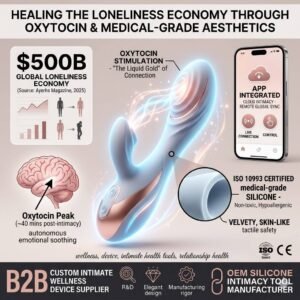
Is the "Liquid Gold" of Oxytocin and Medical-Grade Aesthetics the Ultimate Cure for the Loneliness Economy?
The world is more connected than ever, yet we are starving for intimacy. By 2026, the global "loneliness economy" has

May 3, 2026
Beyond the 180 BPM Spike: How Should Brands Approach Biofeedback Intimate Device Engineering?
✦ ✦ ✦ Wearables have made body data familiar to consumers. Intimate wellness devices create a different engineering question: can