

The Ultimate BDSM Encyclopedia II: Terminology, Market Intelligence, and Safety Protocols (2026 Edition)
March 16, 2026 by
ellenyi@adultstoysgd.com
Market ReportBy Industry Analyst & Safety Consultant
Do you feel overwhelmed by the complex jargon of the alternative lifestyle market? You are not alone. For consumers, a misunderstanding of terms like "RACK" or "TPE" can lead to physical injury or emotional trauma. For retailers and wholesalers, this ignorance is even more costly—leading to the sourcing of non-compliant products, liability lawsuits, and damaged brand reputation. In an industry projected to exceed $62 billion globally by 2030 (Source: Grand View Research), ignorance is not bliss; it is a business risk. This guide cuts through the noise. We will transform confusion into clarity, combining the emotional nuances of the lifestyle with the hard facts of ISO safety standards and material science.
🏆 What is the Modern Standard for BDSM Interaction?
(The Direct Answer)
The modern standard for BDSM interaction is a hybrid of SSC (Safe, Sane, Consensual) and RACK (Risk-Aware Consensual Kink), underpinned by Product Safety Compliance. While SSC prioritizes emotional safety, RACK legally and logically acknowledges that "absolute safety" is impossible. Therefore, a valid interaction requires informed consent regarding all physical risks, psychological limits, and the use of equipment that meets international biocompatibility standards (such as ISO 10993 for body-safe materials).
🚀 Why You Need to Read This Guide (The Bridge)
Whether you are a newcomer curious about your fantasies or a brand manager looking for the next best-selling bondange kit, understanding the mechanics behind the terminology is crucial. The following section answers the most burning questions from both the bedroom and the boardroom.
💡 People Also Ask (Expert Quick-Fire Answers)
1. Is BDSM officially considered a mental disorder?
No. As of the DSM-5 (Diagnostic and Statistical Manual of Mental Disorders), consensual BDSM is not a pathology. It is considered a variation of human sexuality. For brands, this signals a massive shift: marketing should no longer target "shame," but rather "wellness" and "lifestyle exploration."
2. What materials are considered "Body-Safe" for BDSM gear?
For long-term wear (like in TPE relationships), non-porous materials are mandatory. Look for Platinum-Cured Silicone, Borosilicate Glass, or Surgical Steel (316L). Porous materials like TPR/jelly harbor bacteria. Wholesalers must verify REACH compliance (EU regulation) to avoid toxic plasticizers like phthalates.
3. Does the "RACK" principle protect me legally?
Legally, consent is not a defense for assault in many jurisdictions (e.g., the R v Brown case). RACK (Risk-Aware Consensual Kink) is a negotiation tool, not a legal shield. It ensures all parties understand the risks (bruising, marks) before engaging. Documentation is key.
4. How does specific gear impact the "Top" or "Bottom" experience?
A "Top" is an action-executor. Their gear needs established grip and ergonomic handles (for impact play). A "Bottom" is a sensation-receiver. Their gear requires comfort and distribution of force. Retailers should bundle products based on these functional roles (e.g., "The Executive Content Kit").
5. What is the difference between "Kink" and "Fetish"?
A kink is something you enjoy that boosts arousal (a "nice-to-have"). A fetish is often required for arousal (a "need-to-have"). From a product standpoint, fetish markets (like latex or leather) have higher customer loyalty and higher lifetime value (LTV) than general kink markets.
6. Can safe words fail?
Yes. In "non-verbal" scenes or highly altered states (subspace), a verbal safe word might not work. This is why professional players use a "drop object" method (holding a ball; if they pass out or panic, the ball drops, signaling a stop). Safety mechanisms in toys (quick-release buckles) are mandatory for this reason.
7. Why is the "Vanilla" market shrinking?
Data shows a "Kink-ification" of the mainstream. Concepts like blindfolds and light bondage are entering standard bedrooms. The "Vanilla" (conventional) demographic is adopting "Kink-Lite" products. Brands ignoring this crossover demographic are losing 30-40% of potential revenue.
🌍 The Encyclopedia of Dynamics: From Concept to Commerce
To truly understand this sector, we must dissect the core terminology. We will explore what these terms mean emotionally for the user, and what they mean practically for the industry.
1. SSC Principle: The Golden Standard (Safe, Sane, Consensual)
Historically, the BDSM community rallied behind SSC.
- Safe: The activity should not cause permanent harm.
- Sane: All parties must be in a lucid mental state (sober, calm).
- Consensual: Everyone agrees enthusiastically.
📢 The Critical Detail: "Everyone Means Everyone"
Consent is not just between partners. It includes the environment. Public exposure (Exhibitionism) without the consent of bystanders is not BDSM; it is non-consensual harassment.
- Industry implication: Event organizers and club owners must enforce strict "No Camera" policies and vetting processes to maintain the "Sane" operational standard.
2. RACK Principle: The Realist’s Approach
SSC sounds politically perfect. But in reality? It is flawed.
- Is anything 100% safe? No. Driving a car is not safe.
- Is anyone 100% sane? "Sanity" is subjective.
Enter RACK (Risk-Accepted Consensual Kink). This philosophy treats BDSM like extreme sports (e.g., skydiving). You know you could get hurt, but you accept that risk for the thrill.
- Risk Notification: The Top must inform the Bottom of all potential failures (e.g., "This rope could cause nerve damage if left too long").
- The Manufacturers’ Duty: If you sell a suspension rig, you simply must provide load-bearing data. Selling a cheap carabiner for human suspension violates RACK principles and invites negligence lawsuits.
3. TPE: Total Power Exchange (The 24/7 Lifestyle)
TPE is the Formula 1 of the BDSM world. It stands for Total Power Exchange. This is not a weekend hobby; it is a 24/7 dynamic where one partner (the submissive) hands over distinct control of their life to the other (the dominant).
- The Reality: It involves schedules, protocols, and often, long-term wear of devices (collars, chastity cages).
- Product Opportunity: TPE practitioners are the most demanding customers. They need gear that can be worn for 16+ hours a day.
- Comfort is King: Edges must be rolled and smooth.
- Hygiene: Materials must be antimicrobial. Cheap leather rots with sweat; high-grade BioThane or Latigo leather is required.
4. Kink vs. Vanilla: The Ice Cream Theory 🍦
The term "Vanilla" is the perfect antonym for "Kink".
History Lesson: Decades ago, vanilla was the default, most common ice cream flavor produced from vanilla extract. It was reliable, good, but standard.
- Vanilla Sex: Conventional sex. Standard sexual ethics.
- Kink: The "Rocky Road" or "Chili Chocolate" of flavors. It includes BDSM, Fetishism, and Cuckolding (watching a partner with others).
Consumer Insight: If you walk into an ice cream shop and say, "I hate Vanilla!", people think you have a unique palate. The same applies to sex. Paradoxically, the "Vanilla" market is serving as a gateway.
- Trend Alert: We are seeing a merger. "Spicy Vanilla" is a new consumer segment—people who want standard sex but with one accessory (like a blindfold). This is the highest volume sales category on Amazon and Shopify today.
🛠️ Mechanics of Play: Practices & Roles
5. Tickle (Sensory Manipulation)
It sounds innocent. It is not.
Tickle torture (TK) uses the body’s reflex mechanism to induce a state of helplessness.
- The Physiology: Laughter in TK is often a reflex, not joy. The recipient may be suffering, but the body forces a laugh.
- Safety Warning: Because it looks "harmless," amateurs often ignore safe words. This can lead to panic attacks.
- Equipment Insight: Introduction of restraints is common here. Soft restraints (Velcro/Neoprene) are best sellers in this niche because they prevent the "victim" from thrashing and hurting themselves during the involuntary reflex.
6. The Roles: Top vs. Bottom (Breaking the Stereotypes)
There is a massive misconception in the market that a Top is always a Dominant (Dom), and a Bottom is always a Submissive (Sub). This is false.
- Top (The Executor): The person doing the action.
- Bottom (The Receiver): The person receiving the sensation.
Scenario A: A Submissive (Service Top) ties up their Dominant (Lazy Bottom) because the Dominant ordered them to.
- The Sub is the Top (doing the tying).
- The Dom is the Bottom (being tied).
🛑 Why this matters for the "Partner Search":
If you identify as a "Sub" and assume you must always be tied up, but you actually enjoy serving by doing the work, you will be miserable with a Dom who does everything.
- App Recommendation: Dating apps and community forums now distinguish between "Power Dynamics" (Dom/Sub) and "Mechanics" (Top/Bottom). Be precise in your bio to avoid staring at each other awkwardly on the first date!
🧠 The Psychology: Myths, Fears, and Realities
7. The "Am I a Monster?" Syndrome
Newcomer Question: "I have dark fantasies. Does this make me a bad person?"
The Data: Studies indicate that up to 60% of adults have had BDSM-related fantasies. You are not a statistical outlier; you are normal.
The Filter:
A fantasy does not make you "bad." Your actions determine your morality.
- The Benchmark: Do you obtain consent? Do you respect limits?
- If yes, you are exploring.
- If no, you are abusing.
There is a distinct line between BDSM and Abuse. BDSM is a shared journey of pleasure; abuse is imposed violence.
8. BDSM in Movies vs. Reality 🎬
Hollywood (think 50 Shades) is great for box office sales, but terrible for education.
- The Movie: Perfect makeup, seamless transitions, telepathic consent.
- The Reality: You will likely fart during a scene. Stomachs growl. Ropes get tangled. Lube spills on the carpet.
- The Takeaway: High expectations kill the mood. Embrace the messiness. Real intimacy is found in the laughter after the disaster, not just in the scene itself.
9. The "After pleasured in BDSM " Fear
Question: "If I try BDSM, will I find normal sex boring forever?"
The Cycle of Adaptation:
- The Honeymoon Phase: "Wow! Vanilla sex is boring! Use the whip!"
- The Burnout: Sensory overload occurs. The brain adapts.
- The Equilibrium: You start to miss the simplicity of a gentle touch.
Most practitioners settle into a healthy mix. The human body has a self-regulating mechanism. High-intensity dopamine hits (from pain/play) are exhausting. You will naturally crave the oxytocin of "vanilla" cuddling eventually.
🛑 Mental Health & Red Flags: A Safety Checklist
If you are worried about "going too far" or "becoming addicted," use this 4-Point Checklist. You are crossing the line into danger (and potential illegality) if:
- Non-Consensual: You act without permission.
- Permanent Damage: Your actions cause lasting injury or death (even if agreed to).
- Incapacitated Target: You act on someone drunk, high, or in a mental breakdown.
- Life Impact: The lifestyle destroys your job, family, or finances.
B2B Note: If you manufacture products, your packaging must contain warnings against using products while intoxicated. This is a standard consumer protection requirement in the EU and US.
🚑 The "Dark Voice" Protocol:
If you feel a compulsion to do terrible things and cannot stop, seek professional psychological help immediately. There is no shame in hitting the "Pause" button on your lifestyle to fix your engine.
🤝 Finding a Partner: The "Investment" Theory
Why can’t you find a partner? You posted on a forum and nobody replied?
Many newcomers expect the Service Provision Model: "I am here."
The reality is the Value Exchange Model.
Finding a BDSM partner is like a job interview.
- The Bad Investment: Buying a $20 gag and a whip.
- The Good Investment: Learning anatomy, reading about safety (First Aid/CPR), understanding psychology, and building emotional intelligence.
If you bring competence, safety, and trustworthiness to the table, you become a "High-Value Asset." Community leaders and experienced players gravitate toward competence, not just enthusiasm.
How to introduce a Vanilla partner?
Don’t drop a 50-page contract on their lap. Use the "Nudge Method."
- During intimacy: "I think I would like it if you held my hands down a bit tighter."
- Positive Reinforcement: If they do it, express joy.
- The Exit: If they look disgusted, STOP. BDSM is not a requirement for love. You can love someone and never use a whip. Prioritize the relationship over the kink.
✨ Conclusion: The Future is Safe & Educated
The world of BDSM is moving out of the shadows and into the realm of informed consumerism. Whether you are a buyer sourcing the next generation of ISO-certified gear, or an individual exploring the boundaries of your own psyche, the keys to success remain the same: Education, Consent, and Quality.
Don’t settle for cheap thrills or cheap products. The risks are real, but the rewards—a deeper connection with yourself and your partner—are immeasurable. Stay safe, stay sane, and keep exploring.

Latest Articles

July 1, 2026
How Should Brands Choose the Best Lubricant for Their Sex Toy Product Line?
✦ ✦ ✦ For adult wellness brands, lubricant should not be chosen as a random add-on. It should match the
June 30, 2026
Water-Based vs Silicone-Based Lubricants: What Should Adult Wellness Brands Know Before Sourcing?
✦ ✦ ✦ For adult wellness brands, choosing a lubricant is not just a formula decision. It affects product positioning,
May 6, 2026
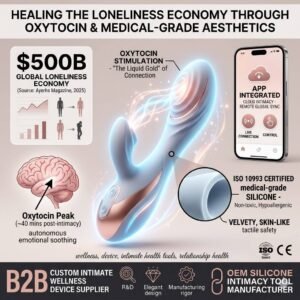
Is the "Liquid Gold" of Oxytocin and Medical-Grade Aesthetics the Ultimate Cure for the Loneliness Economy?
The world is more connected than ever, yet we are starving for intimacy. By 2026, the global "loneliness economy" has

May 3, 2026
Beyond the 180 BPM Spike: How Should Brands Approach Biofeedback Intimate Device Engineering?
✦ ✦ ✦ Wearables have made body data familiar to consumers. Intimate wellness devices create a different engineering question: can