
How Does Sex Toy Logo Customization Work on Existing Products?
October 2, 2026 by
ellenyi@adultstoysgd.com
Product KnowledgeYou have selected a product and prepared your brand artwork. Adding the logo looks like the easy part—until the supplier explains that the original mark cannot be removed, the preferred location needs another process, or the quoted price already includes branding. For sexual wellness brands and distributors, those details affect which model is worth sampling.
📌 Sex toy logo customization starts with the exact material and surface where the mark will appear. Confirm any existing molded logo, assess the artwork and process, review a visual mockup, then approve a physical sample. The quotation should distinguish included branding from additional processing or tooling.
At Kenier Co, these decisions are made against the selected model. Two intimate wellness products in one collection can carry the same brand symbol through different processes and still require separate sample approvals.
Start With the Logo Location, Not the Product’s General Material
A catalog may describe a device as silicone, while its base or decorative component is plastic. A gold-colored surface also does not establish that the part underneath is metal.
In one existing-model project, we discussed an engraved design on the silicone sleeve and silk-screen printing on the gold-plated plastic base. Those were different surfaces on the product, with different proposed branding methods. This example is specific to that model; it is not a universal rule for every silicone or plated-plastic component.
🔍 Before comparing finishes, ask the supplier to identify:
- ✔️ The actual material at the proposed logo position.
- ✔️ Any existing coating, plating or surface treatment.
- ✔️ Whether the area is flat, curved or interrupted by controls or seams.
- ✔️ Which processes can be assessed for that particular component.
Our silicone material and structural design overview gives broader context when a branding request also affects the product structure.
What Happens When the Existing Mold Already Contains a Logo?
⚠️ A logo formed into the product by the existing mold cannot simply be removed from the finished item. Adding another mark and replacing the original mark are different requests.
Tell the supplier early if your product must display only your brand. Otherwise, a discussion about adding your logo may proceed while an existing manufacturer’s mark remains part of the model.
Where the product structure and project arrangements allow it, we can assess a new mold for the silicone sleeve. That route needs its own feasibility review and quotation. A change involving buttons or adjoining parts may require more than a sleeve mold.
| Buyer requirement | What to establish before sampling |
|---|---|
| Keep the existing model and add a brand mark | Whether the original logo remains and where the new mark can go |
| Display only the buyer’s logo | Whether another model or a new tooling route is needed |
| Incorporate the logo during molding | Whether a suitable dedicated mold can be developed |
| Keep existing tooling and apply a mark afterward | Which additional process is feasible and how it is priced |
💡 This is one reason to settle the branding requirement before approving a model for your launch. For projects involving wider changes, see our adult toy customization process.
Gold-Plated and Engraved Logos: Two Different Sample Decisions
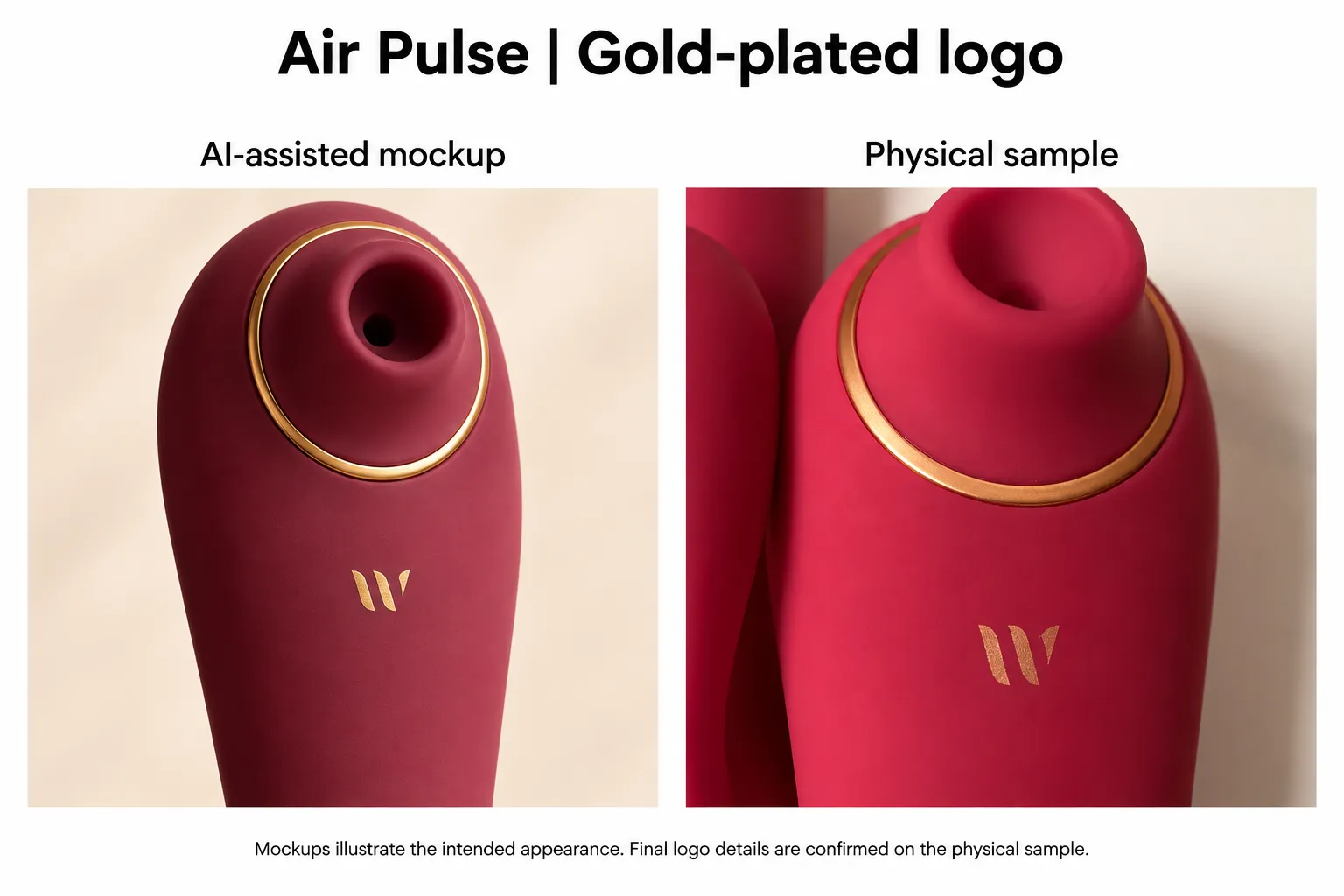
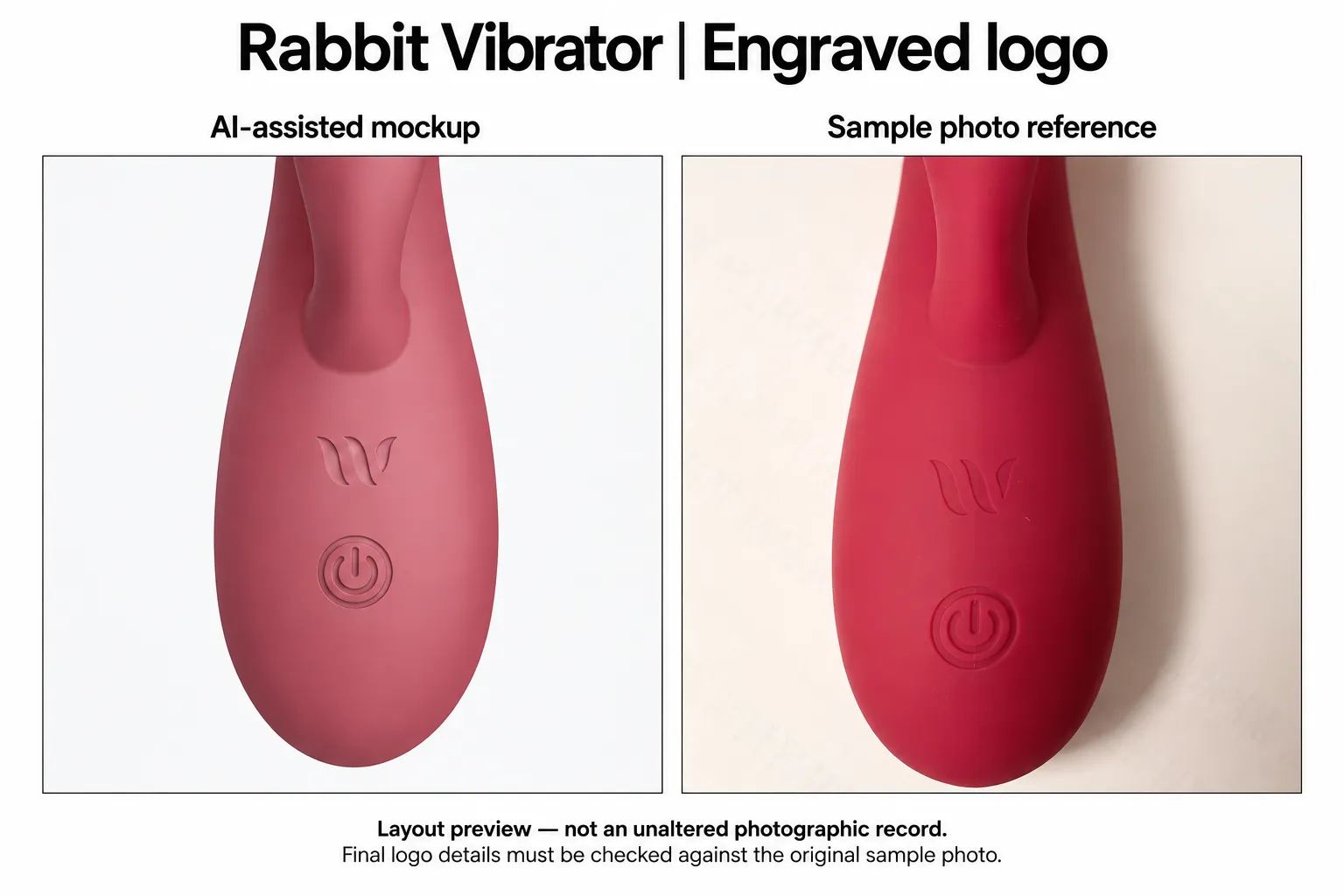
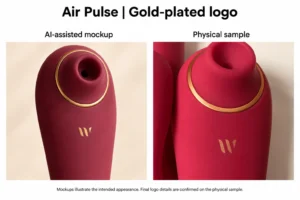
In a two-product branding project, an air pulse stimulator used a gold-plated logo, while a rabbit vibrator used an engraved logo. The same brand symbol created different visual effects: a contrasting gold mark on one product and a recessed, body-colored mark on the other.
📌 The useful comparison is not which method is universally better. It is whether each result matches the brand’s intention on that product.
For the gold-plated logo, review the intended gold appearance, coverage, outline and relationship to nearby decorative elements. For the engraved logo, review the shape of the mark, definition of its edges, visibility and position relative to the controls.
⚠️ Keep the process names accurate in your approval record. An engraved appearance alone does not establish whether laser equipment was used. Likewise, a gold-colored rendering does not identify the actual finishing process. The supplier should confirm the method for the selected sample.
What Should an AI-Assisted Logo Mockup Confirm?
A mockup helps a purchasing team compare options before paying for or waiting for physical samples. It is also useful when a distributor needs its own customer to approve the direction.
We can use customer artwork and process requirements to prepare AI-assisted visual references. Buyers review the overall appearance, logo proportions, position, color direction and intended finish before sampling.
⚠️ The mockup communicates the intended appearance; it is not proof of the finished process. Keep the original artwork available so the production reference does not depend on a generated interpretation of the symbol.
| Review item | Visual mockup | Physical sample |
|---|---|---|
| Position | Shows the proposed area and relationship to controls | Confirms the actual placement on the product |
| Size | Helps compare overall proportions | Allows the agreed dimensions to be checked |
| Color | Communicates the intended direction | Provides a physical appearance reference |
| Fine details | Shows the design intention | Reveals how small lettering and narrow features reproduce |
| Surface effect | Suggests a recessed, printed or metallic appearance | Shows the actual finish, edges and tactile result |
💡 Color differences between a rendering and a photograph can involve the image itself, lighting and capture conditions. Use the agreed color reference and physical sample for approval rather than assuming two screen images establish an exact match.
How Do Buyers Specify Position, Size and Artwork?
Send the supplier the original logo artwork, the selected model and an image showing the preferred position. Include alternative artwork if the brand permits a simpler symbol or a single-color version.
After reviewing the visual direction, record the logo dimensions and its position relative to an identifiable feature, such as a button or the edge of a component. “Centered on the handle” may still leave room for different interpretations.
There is no single minimum lettering size or line width we can promise across every material and process. Ask the supplier to assess your actual file. If a small detail cannot be reproduced clearly, any simplified version should return to the brand for approval.
📌 Where color matters, provide the agreed color specification or a physical reference. If neither is available, an approximate visual selection should be described as approximate. A metallic finish should also be evaluated as a finish, rather than reduced to the color of one pixel in a mockup.
Which Logo Costs Are Included, and Which Are Separate?
The most useful quotation answers two questions: what is included in the product price, and what changes that price?
For many of our existing-model projects, color, logo or engraving customization does not attract a separate sample-customization fee, and logo plate fees are usually not charged separately.
⚠️ That does not make every sample, production process or tooling change free. The selected project quotation defines the actual scope.
| Cost category | What the buyer should confirm |
|---|---|
| Product sample | Whether there is a sample charge and what it covers |
| Logo application | Whether processing is included in the quoted unit price |
| New tooling | Whether a new sleeve or other mold is required and separately quoted |
| Artwork or finish changes | Whether a revision changes the agreed sample or production scope |
| Packaging and freight | Whether these are included or quoted separately |
In a previous project, explaining the additional logo-processing cost created a potential misunderstanding because the original product quotation already included it. A clear quotation should make that distinction explicit, rather than adding the same cost twice.
💡 Also separate product-body branding from packaging or pouch printing. A fee associated with a pouch supplier is not automatically a fee for marking the device itself.
Approve the Mark That Will Be Supplied
🔍 Review the logo sample against the agreed artwork and specification. Record its position, dimensions, orientation, finish, color reference and any existing mark that remains visible.
Ask what checks are appropriate for the intended location and finish, including any agreed wiping, handling or cleaning-related assessment. Define the conditions and acceptance criteria before interpreting results.
⚠️ An attractive sample photograph does not establish wear resistance or a permanent finish.
If a coating or added material changes the supplied configuration, request the information relevant to that configuration. Do not assume a report for another model or an unmodified version covers every branding change.
Keep the approved artwork version and sample identification with the order. For repeat purchases, confirm that the process and specification remain applicable. Packaging artwork and sales photographs should show the version the customer will actually receive.
Questions From Brand and Procurement Teams
Can we use different logo finishes across one collection?
✅ Yes, this can be assessed by model. Approve each product separately while checking that the symbol, visual balance and overall brand presentation remain consistent across the collection.
Can a distributor send a mockup to its retail customer?
✅ Yes. Label it as a visual mockup and identify any details still subject to sampling. This helps the customer review the proposal without treating the image as a finished-product photograph.
What if our logo changes after a sample is made?
Send the revised original artwork and clearly withdraw the earlier version. Ask which sample, tooling or production decisions must be reviewed before the replacement artwork is used.
Can an existing sample show the finish before our logo is ready?
It can help you assess a comparable surface or process. It does not approve the size, legibility or positioning of artwork that has not yet been applied.
Does buying a logo-customized model make the product exclusive?
⚠️ Do not assume it does. Discuss product availability and any exclusive supply arrangement separately from the permission to apply your brand mark.
Should every color variation receive the same visual approval?
🔍 Check whether the mark remains clear against each intended body color. A finish accepted on one color should not automatically stand in for the appearance of every variation.
What should we send to obtain a useful logo quotation?
✔️ Provide the model number or product image, original logo artwork, preferred location, desired finish, quantity and whether any existing logo must be absent. Include your timing and target market.
Bring the Model and Artwork Together
📌 A clear branding decision connects the selected surface, feasible process, approved visual direction and physical sample.
Send Kenier Co your chosen model and artwork so we can assess the available logo route and clarify its quotation scope.

Latest Articles
October 14, 2026
What Can Retailers Learn About Sexual Wellness Marketing From a Brand's Customer Community?
Retailers need reasons for customers to pay attention between purchases. Repeating a discount link can leave product questions unanswered, while
October 2, 2026
How Does Sex Toy Logo Customization Work on Existing Products?
You have selected a product and prepared your brand artwork. Adding the logo looks like the easy part—until the supplier
September 29, 2026
How Is a Pornstar Dildo Developed for a Licensed Brand Collection?
A brand may have an adult performer ready to collaborate, yet still struggle to turn that agreement into a product
September 22, 2026
Adult Wellness Repeat Purchase: What Product Teams Should Review After the First Sale
A strong feature can help win a first sale. It does not guarantee the next one. For adult wellness brands,